Why Wool Is the Best Thing You Can Give Your Pet to Sleep On - And Why Knopped Wool Is Better Still
Natural, chemical-free, and built by nature to look after animals, wool has been keeping living creatures comfortable for thousands of years. Here's why your dog or cat deserves it.
The Problem with Most Pet Bedding - Walk into any pet shop and you'll find shelves of beds filled with polyester fiberfill, memory foam, or synthetic fleece. They look soft. They're cheap. And for the most part, they do a reasonable job, until they don't.
Synthetic bedding traps moisture, harbours dust mites and bacteria, and relies on chemical dyes and flame-retardant treatments to pass safety standards. For a pet who sleeps between 12 and 16 hours a day, the material they're lying on matters enormously, arguably as much as the food they eat. Yet most owners give far more thought to their pet's diet than to where they spend the majority of their lives.
Wool changes that conversation entirely.
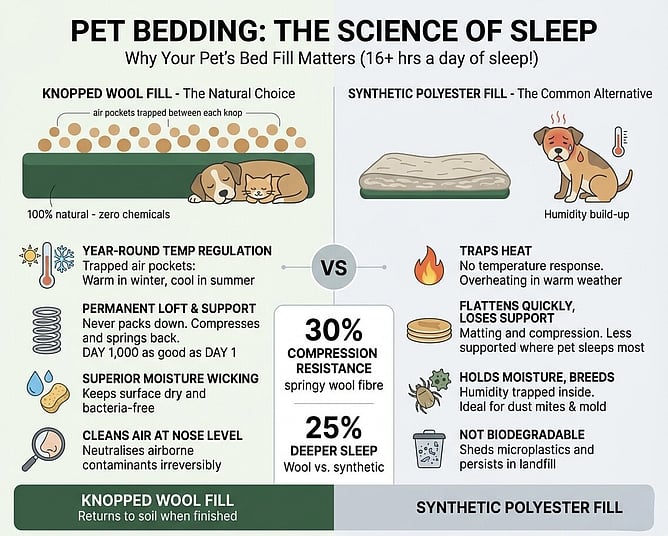
Why Wool Is Extraordinary for Dogs and Cats? - Wool is nature's own thermostat. Its fibres contain tiny air pockets that respond to body heat, holding warmth in when it's cold, and releasing it when temperatures rise. This means the same bed that keeps your dog cosy on a winter morning will keep them cool and comfortable in summer.
This isn't a minor comfort benefit, it's a health one. Dogs and cats don't regulate temperature the way humans do. They can't sweat freely. Overheating leads to stress and, in extreme cases, heatstroke. A sleeping surface that actively helps manage body temperature reduces that risk around the clock, every day of the year.
Wool also wicks moisture vapour away from the body and releases it into the air, keeping the sleeping surface dry. A damp bed is a breeding ground for bacteria and mold. A wool bed stays fresh far longer than any synthetic alternative.
It Protects Joints and Relieves Pain - This is where wool earns its place in veterinary care. Joint problems such as arthritis, hip dysplasia and general stiffness in older animals are among the most common health issues in dogs, particularly in larger breeds. Conventional synthetic bedding compresses over time, offering less and less support exactly when an aging animal needs it most.
Wool provides a naturally cushioned, pressure-distributing surface. Its fibres compress under weight and spring back, forming a stable, supportive matrix that relieves pressure points rather than concentrating them. For animals already on pain medication, a wool bed won't replace treatment but it can meaningfully reduce discomfort during the long hours they spend at rest. Arthritis symptoms are also worsened by moisture and temperature fluctuation, both of which wool naturally keeps in check.
Veterinary clinics and recovery centres have used wool bedding for exactly this reason: it offers therapeutic comfort that synthetic materials simply can't replicate.
It's Naturally Hypoallergenic - Pets get allergies too and one of the most overlooked triggers is the bed they sleep in. Synthetic bedding is often filled with chemical dyes, processed fabrics, and treatments that can irritate sensitive skin or aggravate respiratory conditions.
Natural wool is inherently hypoallergenic. It prevents the growth of bacteria, mold and dust mites, all of which need moisture to survive. For pets with sensitive skin, skin conditions, or asthma, switching to a natural wool bed can make a noticeable difference.
Crucially, wool achieves this without any chemical treatment. It passes hypoallergenic standards simply by being what it is.
It Keeps the Air Around Them Cleaner - Here's something most pet owners don't consider: wool actually absorbs and neutralises airborne contaminants, binding them irreversibly within its fibre structure. For a cat or dog, whose nose is within inches of the floor (and their bed) for most of the day, this matters more than it would for a human.
A wool bed actively improves the air your pet breathes.
It Promotes Deeper, More Restful Sleep - Research has shown that sleeping on wool leads to lower heart rate, reduced sleep disturbance, and more time spent in deep, restorative sleep. Studies conducted at the University of Sydney found that wool's thermoregulatory properties shorten the time it takes to fall asleep and reduce fragmented sleep. While this research focused on humans and infants, the underlying mechanism maintaining a stable, comfortable microclimate around the sleeper applies equally to our beloved pets.
A deeper sleeping animal is a healthier, calmer, better-rested one. Given how central sleep is to physical recovery and immune function, this is no small thing.
It Lasts - Wool fibre is naturally springy and resilient, capable of being compressed or stretched up to 30% and still returning to its original shape. A well-made wool pet bed won't flatten into a useless pancake after a few months the way a polyester-filled bed will. It holds its form, its support, and its benefits for years.
Why Is Knopped Wool Even Better?
Standard wool bedding is excellent. Knopped wool takes everything that makes wool remarkable and amplifies it.
Knopped wool sometimes called wool knops or wool pearls is wool that has been processed into small, rounded balls of fibre. Rather than lying flat in sheets or batts, the fibres are mechanically formed into tight little spheres that hold their shape through wool's own natural crimp, with no adhesives or binding agents required.
The result is a fundamentally different structure and one with distinct advantages for sleeping animals.
Superior Air Capture and Insulation - Each knop is essentially a tiny air-trapping sphere. Where flat wool creates air pockets between fibres, knopped wool creates air pockets within the knops themselves, as well as between them. This layered air capture gives knopped wool significantly greater insulating power than the same weight of conventional flat wool fill.
For temperature regulation, already one of wool's strongest traits, knopped wool raises the bar considerably. The stable microclimate it creates around a sleeping pet is more consistent, more responsive, and more effective.
It Doesn't Flatten or Pack Down - This is perhaps the single most important practical advantage of knopped wool for pet bedding. Conventional fills synthetic or otherwise compress under repeated use. The areas where your pet sleeps most often become flattened and unsupportive, often within months.
Because knopped wool fills are engineered to resist compression, the knops push back against pressure and return to shape. The bed your pet sleeps on in year three provides the same support as it did in week one. For arthritic or joint-compromised animals, this long-term resilience isn't just a comfort benefit it's a health guarantee.
Even Better Moisture Management - The ball structure of knopped wool dramatically increases the total surface area of the fill. More surface area means more capacity to absorb moisture vapour, wick it away from the sleeping surface, and release it into the surrounding air.
Where conventional wool bedding already outperforms synthetics on moisture management, knopped wool outperforms conventional wool. For puppies, elderly pets, or animals recovering from surgery where skin integrity is more vulnerable this enhanced dryness significantly reduces the risk of sores, irritation, and infection.
Purely Natural, With Nothing to Hide - Premium knopped wool fill contains no synthetic fibres, no chemical additives, no plasticisers, and no glues. The knops hold their shape through the wool's own natural crimp — a structural property, not a chemical one. For owners who want the cleanest, most transparent possible bedding for their animals, knopped wool is the benchmark.
It is also fully biodegradable. When the bed eventually reaches the end of its life, it returns nutrients to the soil rather than adding to landfill.
The Science Behind the Structure - Wool fibres have a natural helical crimp a wave or coil structure at the molecular level. This crimp is what gives wool its elasticity and bulk. When processed into knops, that crimp is exploited to maximum effect: the fibre is coiled not just at the level of individual strands but at the level of the entire ball, creating a compound resilience that no flat fill can replicate.
Strong wool varieties typically in the 30–40 micron range are best suited to knopped fill, offering greater compressional resilience and durability than fine wools like romney. The result is a fill that is robust, long-lasting, and highly functional without sacrificing the natural warmth and breathability that wool is known for.
The Bottom Line - Your dog or cat spends more time sleeping than doing almost anything else. The surface they sleep on shapes their temperature, their joint health, their skin, the air they breathe, and the quality of their rest. Most pet bedding treats this as an afterthought where wool bedding doesn't. It was engineered by millions of years of evolution to regulate temperature, manage moisture, and keep a living creature comfortable because that's exactly what it did on the animal it came from.
Knopped wool takes that inherited intelligence and makes it structural. Better insulation, better resilience, better moisture management, and a bed that stays as good on day one thousand as it was on day one.
For the animals that give you everything, give them the best!